It’s Margarita Time with Professor Kathleen Offenholley


I have personally known Professor Kathleen Offenholley, Associate Professor of Mathematics at Borough of Manhattan Community College, only for a couple of months. Since Day 1, however, I have always been enjoying her laid-back manner and all-round knowledge, let alone her expertise in math and teaching. The moment I learned two of her non-math interests are karate and quilting (the photo above is of one of her creations), I became so determined that my next Math Blog interview would be with her. Finally, I met with Professor Offenholley at a Mexican restaurant in TriBeCa near the campus. The weather was so perfect that we ate outside!

Tell me about your childhood. Were you good with math when you were little?

I was born in Pennsylvania but grew up in Massachusetts. My parents are both scientists… they were physical chemists and faculty. So, talking about science and being able to do math was a norm and expected in my family.

That’s a really good environment.

Yes, it was very encouraging. Many women in math and science talk about the influence of their parents… how helpful and encouraging the parents were and that it was normal to do math and science as a girl. That was true for me growing up.

It’s very interesting, although not surprising, that most of the professors I’ve interviewed had teachers and professors in their families. So, becoming a professor was sort of a natural path for you, would you say?

When I went to college, I was actually going to be a sociology major. But I became an after-school teacher while taking some time off from school, and I loved it so much that I decided to go into teaching. I thought about what I’d like to teach, and then decided to become a math teacher. I went back to school and redid all the math courses, so it took me a while to graduate from college, but it was fun.

Then you got a Ph.D. in math education from Teachers College of Columbia University. Tell me a bit more about your love for teaching.

Teaching is never routine. It’s always different and I like that. I think I first went into teaching because I like to explain things to people. But if you’re a good teacher, you don’t spend a whole lot of time explaining things. You think about what students could do so that they’re going to understand. At BMCC in my math department, about half of the professors have math education degrees and the other half pure math degrees. It’s a good balance because each has different strengths and qualities, and we can give each other good ideas.

I understand that you’re working on a project about gaming in math classroom.

It’s a relatively new thing and I like being on the edge of new things. I play a lot of games with my students… sometimes my original games, sometimes I use what I learned in a conference, books, and such. Games have elements of experiential learning, active learning, and collaborative learning, and I use games to convey math, of course, not just for the students to have fun. Last year, two of my colleagues at BMCC, Professors Crocco and Hernandez, and I were awarded a C3IRG grant (Community College Collaborative Incentive Research Grant) from CUNY Central office to do research on game-based learning. We just started data collection and analysis.

Can you give me an example of the games you and your students play?

I created bingo games. For example, one of them is a “hypothesis test” bingo. The bingo cards have words from my hypothesis test lecture, which is one of the hardest lectures for students with a lot of new vocabulary and concepts and all. During the lecture whenever I say one of the words on the cards, students cross it off on their cards, and they get to shout out, “Bingo!” in the middle of the lecture. Instead of being made desponded by the difficult topic, the students have a good time. And then they turn the bingo cards over, there’s a vocabulary-to-concept matching task. So the students actually have to pay attention to the lecture, not just play the game and have fun. They don’t leave the classroom being all sad and helpless. They leave feeling, “That was really fun,” and become ready to do the work to learn more. 

Many psychology research studies have shown a positive relationship between excitement and memory, and the effect of gaming in classroom may be related to the results of such studies. It seems, however, that the use of games is sometimes criticized by other professors?

Yes! There is still a lot of misconception about gaming. Some people think I just jump up and down with my students and that’s all I do. Recently, one professor told me that playing games in classroom is not good because the students would then think it’s all about fun, and life is not fun… That’s really sad.

Life is not always fun, but life or math shouldn’t be all about pain! Now, speaking of fun, I have to ask you about your hobbies!

Two of my hobbies are quilting and karate; I’ve been quilting since my son was born… for 14 years, and karate for 24 years! As for karate, I go to a women’s karate school, which is a program at the Center for Anti-violence Education in Brooklyn. They teach self-defense to children, teens, and survivors of violence. I was going there once a week for a while, but now that my son is older, I get to go more often!

The keynote speaker of this year’s CUNY Math Conference, Dr. Caren Diefenderfer of Hollins University, was talking about crochet as one of her hobbies, or did she say she wants to take it up as a new hobby? Anyway, she was talking about the connection between crocheting and math, in terms of understanding patterns.

I remember Dr. Diefenderfer’s talk. She described crochet as “mathematical manifolds”! I think quilting, knitting… these activities are also related to math and help us to understand shapes and patterns. Math is all about finding beautiful patterns.

The two other female professors I’ve interviewed for the blog both mentioned knitting… That’s not a coincidence, I suppose?

Probably not!

We then talked about tapas bars, sangria, and also a bit about reading for fun; more specifically, about NOT reading for fun as much as we used to. Professor Offenholley said she had just started reading Murakami’s “1Q84,” which I finally started last week. It’s a huge book, and I wonder if she’s done with it by now. We may have an informal book club meeting sometime in the future.

(This interview was conducted on June 19, 2012)


Posted in Uncategorized | 10 Comments

The data deluge

The theme for Math Awareness Month this year was “Mathematics Statistics and the Data Deluge.”

The April issue of SIAM News had an interesting article titled Got Data: Now What? The article identified the analysis of large data sets to provide understanding, and ultimately knowledge, as one of the fundamental intellectual challenges of the times. It called on mathematical scientists to develop novel methods based on their domain expertise, and to see these developments translate into value for society.

To this I would add that along with new applications come new ethical issues. See for example, You for Sale: Mapping, and Sharing, the Consumer Genome and Predictive Policing.

The question is how to include these new applications in existing courses and what sort of new courses should be designed. It is difficult to do a thorough job of covering theory (read theorems and proofs) and applications all in one course, especially advanced applications, where the context has to be developed to make sense of it. Emphasis on data tends to shift the entire focus of the course. It takes quite a bit of time too, since students have a variety of capabilities and comfort level with software.

One way for math majors to gain familiarity with this topic is to take a course on it, perhaps a capstone course. Another way is to participate in an undergraduate research experience.

In lower-division math courses like Calculus etc. some of the standard applications could be replaced by these newer ones.

At Brooklyn College we have a Math Club Colloquium for the students. Many of the talks last spring were related to the theme of Math Awareness Month.

Any other ideas on how to incorporate emerging fields into the mathematics curriculum?

Posted in Uncategorized | Tagged | 5 Comments

Homework

One of the most effective teaching strategies in lower division service courses like pre-calculus, calculus, mathematical thinking etc. is to assign a good amount of homework. A good amount tends to be an individual call. You know it is a good amount when some, but not all, students complain.

Well, perhaps all will complain! So let’s call it an effective, but unpopular, teaching strategy.

It is definitely a time-intensive teaching strategy since students must get feedback on what they do. One way to save time while assessing routine homework is to check just a few of the problems. For example, in a homework set of 15 problems on solving linear equations, if the student knows how to solve an equation with variables on both sides, and brackets, and fractions, then the student knows everything else and it doesn’t matter if there are a few errors here and there. I tend to be generous in grading homework and I accept late homework. I take off a nominal amount for errors and lateness, but then allow them to earn it back at the end before the final exam.

I am, however, firm about students completing and turning in all their homework even if it is late. Mostly I do this by getting to know the students and asking them about homework throughout the semester.

The reward is captured in the following scatter plot of data from one of my lower-division classes last semester (Mathematical Thinking). The figure has homework scores on the x-axis and final exam scores on the y-axis. The correlation coefficient is 0.7. The cluster of point near 100 on both scales speaks for itself. (I gave students 6 bonus points on the final in case anyone notices that a couple of the exam scores are over 100.)

What about you? Do you assign homework? If so, is there any correlation between homework scores and final exam scores in your classes?

Of course, correlation does not imply causation and this is well illustrated in one of my favorite tongue-in-cheek books How to lie with statistics by Darrell Huff. Nonetheless, it is interesting to get some solid evidence to back-up favorite teaching strategies.

Posted in Uncategorized | Tagged | 20 Comments

Existence

I was wandering in my neighborhood bookstore this morning, when I came across a new edition of The Greek Myths, by Robert Graves.  Attracted by the cover, and my love of the Claudius series, I decided to bring it home.   Maybe this is a sign of unhealthy obsession, but the very first myth immediately put me in mind of mathematics.

The Pelasgian Creation Myth is already available on Amazon preview, so there can’t be much harm in my transcribing it here:

In the beginning, Eurynome, the Goddess of All Things, rose naked from Chaos, but found nothing substantial for her feet to rest upon, and therefore divided the sea from the sky, dancing lonely upon its waves.  She danced towards the south, and the wind set in motion behind her seemed something new and apart with which to begin a work of creation.  Wheeling about, she caught hold of this north wind, rubbed it between her hands, and behold! the great serpent Ophion.  Eurynome danced to warm herself, wildly and more wildly, until Ophion, grown lustful, coiled about those divine limbs and was moved to couple with her.  Now, the North Wind, who is also called Boreas, fertilizes; which is why mares often turn their hind-quarters to the wind and breed foals without aid of a stallion.  So Eurynome was likewise got with child. 

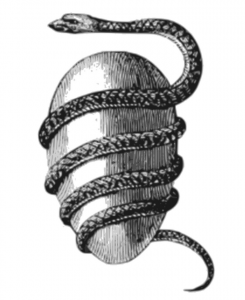
Next, she assumed the form of a dove, brooding on the waves and, in due process of time, laid the Universal Egg.  At her bidding, Ophion coiled seven times about this egg, until it hatched and split in two.  Out tumbled all things that exist, her children:  sun, moon, planets, stars, the earth with its mountains and rivers, its trees, herbs, and living creatures.

Orphic egg

The Orphic egg

The reason this story interests me, apart from its inherent attractions and historical significance, is that it is a kind of existence argument.  Obviously it is completely implausible that the world began with Eurynome dancing for warmth upon the waves.  But at the same time, the story has a compelling logic to it — as you read it (in a certain state of mind anyway) the evolution of the plot makes sense.  The north wind came from Eurynome moving south–when grasped, it became a snake.  Since the north wind fertilizes, the snake Ophion and Eurynome were able to conceive the Universal Egg, which then hatched to produce all things that exist.

Those who consider it important that mathematics be founded on a self-evident logical base should experience discomfort when something that is patent nonsense from one point of view seems plausible from another.

We can try to “explain” the existence of, say, the real numbers in the same way that the myth explains the existence of the world.

In the beginning, the integers emerged naked from \aleph_0.  The integers begot the rationals, and Dedekind cuts arose from the rational numbers.  The cuts ordered themselves by inclusion, and learned the operations of + and \cdot from the rational numbers of which they were descended.  Next, a well ordering emerged from chaos and placed itself upon the Dedekind cuts, but, due to its great diffidence, hid itself in such a way that it could not be seen. 

I appreciate that this “sociology of science” sort of argument can be irritating in the extreme.  To read Latour, for instance, is to desire to kill him:

Latour

Bruno Latour

I am certainly not saying that there is no essential distinction between math and mythology.

Still, I do think there are non-trivial similarities between creation myths and foundational “explanations” of modern mathematics.  Both seem to be in sympathy with a natural feeling that we can better understand our world by knowing its origins, or the secret of its creation.

Ostensibly the purposes of foundational constructions in mathematics are not to explain per se.  The purpose of basing mathematics on various axiomatic systems, for instance ZFC, is to infuse the subject with greater rigor.  The added rigor is supposedly the result of reducing and clarifying the “unjustified” and undefined concepts which must be accepted without proof. Further, proofs following from formal axioms become purely combinatorial, and therefore, it is thought, more reliable.

But isn’t mythology also intended to reduce the multiplicity of unnecessary entities?  Isn’t that what makes it seem like an explanation?

There is definitely something about an axiom system that seems “explanatory.”  This is paradoxical, because the objects and relations which feature in any set of axioms are necessarily undefined.  Here is a stunning quote on this subject from Kurt Gödel (apparently in Mehlberg, Henryk. Logic and Language. Dordrecht: D. Reidel Publishing Co., 1962.)

The role of the alleged “foundations” is rather comparable to the function discharged, in physical theory, by explanatory hypotheses….The so-called logical or set-theoretical foundation for number theory or of any other well established mathematical theory is explanatory, rather than foundational, exactly as in physics where the actual function of axioms is to explain the phenomena described by the theorems of this system rather than to provide a genuine foundation for such theorems.

What does this mean?

One obvious interpretation of the quote is that axiom systems are vulnerable to empirical falsification — something different than the danger of internal inconsistency. In this reading, as Morris Kline puts it, “truth does not flow upward.”  The axioms are not the source of the validity of theorems–they are only plausible explanations of why theorems are empirically true.

This quote seems so unlikely coming from Gödel that Charles Parsons questioned its authenticity (for which I guess we have to trust Mehlberg).
At any rate the construction of axiomatic systems should not be trivialized.  To compare the construction of the reals with a creation myth belies the great technical difficulties involved in achieving such a construction.

Posted in Uncategorized | 10 Comments

Mysterium Cosmographicum

Why study mathematics? This is a catechism of mathematics education. The correct answer has something to do with the prevalence of mathematics, its applicability, its beauty, and its power.

What kind of person studies mathematics, and why? Again, there are plenty of answers. The student of mathematics, like students of other sciences, is curious, but patient and dogged. She or he is motivated by a fascination with the intricate patterns that make up the universe.

There is something to these inoffensive responses. But they are also highly sanitized and at odds with a realistic view of human nature. I can’t help but feel that when we advance them we are demonstrating a little bit of hypocrisy. A lot is being swept under the rug.

I posit the following four sources of motivation to study pure mathematics. They are not meant to be mutually exclusive, or very original.

  1. The entelechy of genius
  2. An urge toward vandalism
  3. The transcendental
  4. Shibumi

Let me briefly expound on these.

1)

This beautiful word, entelechy, as I understand it, means the state of something expressing its own inherent virtue. By the entelechy of genius I mean that there are certain great personalities, profoundly gifted, whose natural state seems to be in expressing their own special powers. I think a lovely quote to pair with this notion is the following well known morsel by François Arago.

Euler calculated without apparent effort, as men breathe, or as eagles sustain themselves in the wind.

While any number of famous mathematicians could be put down as especially expressing this category of motivation, it brings to mind the greatest of the great: Archimedes, Euler, and Gauss.

I am inclined also to add Ramanujan, Erdos, and Saharon Shelah for a bit of contemporary flavor. They demonstrate a lifelong torrent of mathematical activity– mathematics seems to emanate from them without obvious effort.

2)

This is the attention-seeking form of self expression. It includes creation for the sake of self-aggrandizement, and domination.

3)

This is the idea that there are truths about the universe that can be discovered, expressed or proven in mathematical form. Here is Russell explaining this to be the source of his own motivation (plug your ears for the sex parts):

In this category I include all Platonists, and most mathematicians who lived before the 19th century. Astrology and numerology, as well as sacred or hermetic geometry can go in this category.

Pleasure that comes from contemplating the infinite should also be included.

4)

The wonderful Japanese word shibumi can be summarized as referring to a form of harsh but sublime beauty. I believe it is an excellent word for characterizing the precise sense in which mathematics is beautiful. It is true that some visual components such as fractals, julia sets, and these amazing complex plots have a kind of rococo and/or psychedelic quality. However, all of them are manifestations of expressions and processes that are very simple.

I believe we partake of all the above motivational sources when we undergo an episode of mathematical creativity.

How many of these four kinds of mathematical motivation are available to our students? Which would we want them to have? The vast majority of our student body (or of any population) is not comprised of geniuses. We hope that our students will not become mathematicians out of masochism, or a savage urge for intellectual accomplishment and domination. This leaves the transcendent and shibumi as socially acceptable, or “healthy” motivational sources we can impart.

The aesthetic answer, I think, is well represented in traditional answers to the question of what makes mathematics worthwhile. This may be based in the eloquence with which Hardy, a devoted secularist, expressed these views in A Mathematician’s Apology (ff pg 15).

What I think is unjust, and what rankles with me as overcautious, is the suppression of the importance of the transcendent as mathematical motivation. It is true that many mathematicians were seemingly motivated by a simple desire to discover theorems. But many of them were motivated by the urge to penetrate the veil of reality, to discover or understand the divine, or even to acquire godlike qualities. Many people, from the Pythagoreans to Plato, to Pascal, Descartes, Newton, Cantor, Weyl, Russell and Gödel have either compared the consolations of mathematics to those of religion, or else claimed to have extracted actual knowledge of the divine through mathematics.

One of the great popular math books, The Mathematical Experience by Davis and Hersh, clearly takes as its model The Varieties of Religious Experience, by William James. In this book there is an amusing caricature of the “ideal mathematician” whose motivations realistically reflect what motivates true mathematical activity.

To talk about the ideal mathematician at all, we must have a name for his field. Let’s call it, for instance, “non-Riemannian hypersquares.”

He is labeled by his field, by how much he publishes, and especially by whose work he uses, and by whose taste he follows in his choice of problems.

He studies objects whose existence is unsuspected by all except a handful of his fellows. Indeed, if one who is not an initiate asks him what he studies, he is incapable of showing or telling what it is. It is necessary to go through an arduous apprenticeship of several years to understand the theory to which he is devoted. Only then would one’s mind be prepared to receive his explanation of what he is studying. Short of that, one could be given a “definition,” which would be so recondite as to defeat all attempts at comprehension.

The objects which our mathematician studies were unknown before the twentieth century; most likely, they were unknown even thirty years ago. Today they are the chief interest in life for a few dozen (at most, a few hundred) of his comrades. He and his comrades do not doubt, however, that non-Riemannian hypersquares have a real existence as definite and objective as that of the Rock of Gibraltar or Halley’s comet. In fact, the proof of the existence of non-Riemannian hypersquares is one of their main achievements, whereas the existence of the Rock of Gibraltar is very probable, but not rigorously proved.

It has never occurred to him to question what the word “exist” means here. One could try to discover its meaning by watching him at work and observing what the word “exist” signifies operationally. In any case, for him the non-Riemannian hypersquare exists, and he pursues it with passionate devotion. He spends all his days in contemplating it. His life is successful to the extent that he can discover new facts about it.

I do not believe (nor do Davis and Hersh really believe) that a typical mathematician is as naïve as their ideal researcher. But something about their characterization rings true; all the greatest mathematicians I know are fanatical Platonists. Without the conviction that one is prying open the doors to heaven, why would you passionately devote your life to adding a new block to an already grotesque mass of inaccessible scribbles? Of course many people believe two things at once—as Davis and Hersh remark, many mathematicians are Platonists in the week and formalists on Sundays.

You cannot hypnotize a student into developing a badger-like constitution, but you can easily interest him or her in the mysteries of the universe, of which many are highly accessible. We may not be able to spend much class time on the hieroglyphic monad or peruse Gödel’s ontological proof for the existence of God, but there are mysteries of a more secular character.

What, for instance, is the solution to the problem of induction (in the sense of Hume)? How and when is inductive reasoning correct? What is probability? What is causality?

Does the infinite exist potentially, or actually?

What is the relation of the continuous to the discrete? Are there infinitesimal quantities? Are there infinitely large quantities?

What is computable? What is knowable? Why and to what extent is mathematical argumentation reliable?

I think it must be the case, as it certainly is in my own case, that these questions or similar ones are the true source of the interest we have in our research specializations.

In the current mood of postmodern agnosticism as to the meaning of mathematics, the positivist face we publicly wear as scientists, and the white knuckled secularism that is universal in modern education, it is perhaps difficult to relax enough to reveal the incomprehensible vortex of uncertainty that remains at the core of our intellectual lives. But the mesmeric allure of that vortex, whether true or illusory, is a longstanding source of motivation for scientific endeavor, and we should consider sharing it with our students.

Posted in Uncategorized | 73 Comments

Thinking ahead.

At the end of her Kindergarten year, my daughter’s teacher decided to introduce the concept of dimensions to the students. She explained the difference between the three-dimensional objects, like a piece of fruit, for example, and two-dimensional ones, like a piece of paper.

She told them that the way to distinguish between them is to see that the 3-d ones don’t need to be supported to stand, while the 2-d ones will fall down and lie flat. I had the laugh of my life that evening when my 5-year-old proclaimed that the little babies are two-dimensional because they can’t stand on their own, and become three-dimensional when they grow up a bit and can stand by themselves.

While this example is funny and probably harmless, it illustrates
the importance of choosing the words really carefully when teaching children. Here is a not-so-harmless one. At the end of the first grade now, a different teacher informed my daughter’s class that addition is the same thing as subtraction. What she meant (I hope!), is that from the fact that when you add 2 and 3 you get 5 it follows that when you subtract 3 from 5, you get 2. In elementary schools these days they say that the math sentences 2+3=5, 5-3=2, and 5-2=3 belong to the same “number fact family”. My kid, however, only heard the “addition is the same as subtraction” part. I let it slide the first time she told me that, because it is SORT OF true, addition IS the same thing as subtraction. In a few days, however, there was trouble. My daughter, who, until then, was perfectly capable of solving the addition/subtraction word problems, was stumped by something like this:

 Mary has 6 apples, Jack has 4 apples. How many more apples than Jack does Mary have?

What are you supposed to do, add or subtract? You were just told that addition is the same thing as subtraction, so why not add?

At this point I realized that I cannot trust my child’s mathematics education to her school. I see way too many college students who just “cannot get” math because of the misconceptions instilled in them when they were in grade school, let alone who don’t know their multiplication tables because of the lack of practice. I don’t want my children to become mathematicians, but I don’t want them to suffer in high school and college the way my students suffer. Way too many of them have to give up on their dreams, which have nothing to do with mathematics, like medical school, nursing degree, pharmacy school, because they can’t get through the required math courses.

But I don’t trust myself with teaching mathematics to elementary school kids either. I cannot project the methods I use with adults onto little ones. There is a reason why the degree in elementary education exists, the elementary school teachers are supposed to know how the little brains work, and teach mathematics appropriately. This brings me to the issue of “Saturday School”, those extra math classes that so many children take these days, at the expense of family time, playground time, etc…, let alone money. Here is my daughter’s take on her extra math class, which follows the Singapore Math curriculum. Her regular school follows Pearson Success enVision Math now, which is much better than Everyday Math that many schools still follow, actually.

Fourth grade Singapore Math is not really 4th grade.
“Grrr!” Go all of my classmates while doing Singapore “Grade 4” math. “This is so easy” all of my classmates say while doing Pearson Success enVision Math. What I mean by this is that 4th grade Singapore Math is not really 4th grade. Let me explain.

Ugh, Singapore Math is just so annoying. It is very, very hard. From my perspective, 4th grade Singapore Math is just way too hard for me, as a fourth grader. I have examples. For example, do 4th graders multiply, divide, add and subtract decimals? I don’t think so. But, in Singapore math, that’s just what they do. Also, what 4th grader multiplies and divides units of measurement? I don’t know, yet that’s just what we do in Singapore Math. One example of this is when they ask you to calculate 6 km 250m times 5 and 3 kg 300 g  divided by 3. I mean, who does that when they are 9 years old? It doesn’t make any sense to me. Do you see what I mean? I really hope you do.

Now let’s turn to the bright side of things. The Pearson Success enVision Math side. As I mentioned before, it is very, very easy. At my school, I finish as one of the fastest finishers in my class and still get the answers all correct. This is the better side of things. We do not do crazy stuff such as the 4 operations of decimals nor do we do multiplying and dividing units of measurement. We do things that are much simpler. For example, we go back to the easy stuff such as adding with base ten blocks. Yes, I know it might sound as if I am in 1st grade but we do it as a review. Don’t you see how much better it is to do easier stuff? It doesn’t make any sense for 4th graders to do work as hard as Singapore Math.


In conclusion, I hope that you realized why I think that 4th grade Singapore Math is not really 4th grade. I hope that teachers who teach Singapore Math are going to start explaining it to the kids and telling them that it is hard work to do Singapore Math, as I proved in this essay.

As you noticed, she learned the fine art of the 4-paragraph compare-and-contrast essay already, but I don’t think I am qualified to comment on English instruction issues, so back to mathematics.
I did a follow-up “interview” with her.

Q: Why do you think it is so easy for you to do the 4th grade Pearson Success enVision Math?
A: I think it is easy because my teacher explains everything to the kids. She makes sure they understand everything she says.
Q: How do you know that everybody understands?
A: I know that everybody understands because my teacher explains it a billion times in a billion different ways.
Q: But you wrote in your essay that you are usually the fastest. Why do you think that is?
A: I think it is because the stuff we do is very easy. I know what answer you want. It’s that I finish fast because I go to Singapore Math, but that is very not true, because kids that do not go to places like E-nopi, Kumon, or any other extra math still finish in a snap.
Q: But there are plenty of kids who get 2’s on their math tests.
A: I know, that’s because their teachers just tell the stuff and say (without explaining it a billion different times in a billion different ways) go back to your seat and do the following problems.
Q: How do you know what other teachers do???
A: I know because I have been in their classrooms and I saw them teaching math. It is not good.
Q: How do you know about E-nopi and Kumon? You never went to those.
A: The kids who did go told me about the place and what they learned.
Q: How many kids in your class go to some extra math class?
A: 1/8-1/4

She is a smart kid. She figured out right away what I want her to say, and avoided that with all her might. Unexpectedly, she touched upon the problem of teacher’s quality (and we don’t talk badly about teachers at home, EVER, after all, all women in our immediate family are teachers of some sort), but it’s a different story.

But I know the truth :-). It is not even the quantity of those extra math problems that she has to do. In fact, we switched from one Saturday school to another, Tuesday one, because the former became too “drill-and-kill”. It has more to do with the quality of the problems. In regular school, most of the problems are single-step, with just a few two-step ones.

From Kindergarten to fourth grade, the numbers changed from single-digit to multi-digit, the operations changed from addition to long division, but conceptually the problems didn’t become harder, they are still mostly one-step action. What I like about that Singapore Math curriculum is their focus on the multi-step thinking process. It is a very useful skill, to be able to see through a few steps ahead, like in chess, to see what your immediate action would lead to.

Look at the problems she mentioned. In regular school, they learned that 1 kilometer is a thousand meters, and 1 kilogram is a thousand grams, and THAT’S ALL they learned. They are not supposed do anything with this information. It is no surprise that these facts are not retained, and have to be taught again and again. In Singapore Math, they actually do something at least remotely useful with it.
And it doesn’t hurt that it’s one year ahead of the regular school curriculum.

Now, if only the Singapore Math had just a bit more “drill” in it…


Posted in Uncategorized | 9 Comments

About the header image, part 3: New results!

There is often a feeling that anything truly new in mathematics must, of necessity, be obscure, arcane, and require several years of study to understand.  I’d like to talk about a result that was published in the most recent edition of the Notices of the American Mathematical Society, with the somewhat-scary-title “Isoperimetric Pentagonal Tilings.”   This is cool for several reasons: First, it’s accessible to anyone, really — if you’ve ever spent a few moments staring at a tiled floor, you can get the general idea (I’ll give a description below).  Second, it’s a collaboration between Professor Frank Morgan of Williams College and a group of eight undergraduate research students (Ping Ngai Chung, Miguel A. Fernandez, Yifei Li, Michael Mara, Isamar Rosa Plata, Niralee Shah, Luis Sordo Vieira, Elena Wikner).  Third, it features the Cairo tiling which appears in our header image.  Fourth, it’s brand-new — this is a mathematical question that, a year ago, was simply unanswered.  And now we know the answer.  That’s cool!

The topic of tilings have a long history, which I will not go into.  But the idea is demonstrated in every brick wall, cobblestone street, and tiled floor — we want to fit together shapes to cover a flat surface.  Great examples of square, rectangle, and hexagonal tilings appear in the street photos in Mari’s previous post on the header image.   Now, as with many mathematical problems, the particular aspect of tiling that we want to consider today is best viewed as a game.  Here’s the game:

Tile a plane with shapes so that the combined perimeters of those shapes is as small as possible.

To make this game concrete, suppose we are sketching our tiles on a playground with chalk — what shape will require the least amount of chalk, in order to cover the entire playground?  Squares, triangles, diamonds, etc?

As is often the case, once you start playing around with a game like this you realize that it makes sense to add some additional restrictions:

  1. You can reduce the total perimeter by making the shapes larger — it uses less chalk to draw a single square encompassing an entire playground than it does to break the playground up into many smaller squares.  Because of this, we insist that all shapes be the same size — that is, each shape used must have equal area.  We make a typical math-y decision: since it doesn’t matter exactly what the area is, as long as all the shapes we are comparing have the same area, we decide (arbitrarily) to make all shapes have area equal to 1.
  2. Are we allowed to use more than one shape?  Well, since we’re making up the rules, we can go either way on this one — and, in fact, depending on how we decide, we get two different versions of the game, the “same shape” game, or the “collection of different shapes” game.

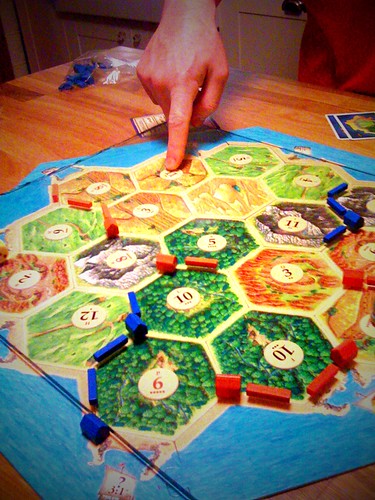
First, let’s talk about past results:  In 2001, Thomas Hales proved the “Honeycomb Conjecture” — the least-perimeter tiling of the plane is, in fact, given by a single shape, the regular hexagon.  This tiling is popular with board-gamers, pipe-stackers, and bees:

Settlers of Catan (board game)

pipes

Pipes stacked in hexagonal pattern

Honeycomb

Honeycomb

This settles the “most obvious” question, maybe, but unlocking a door is good motivation to look for another door (with a better lock)(or so goes the logic of the mathematician). Hexagons have “been done” — so what happens if restrict ourselves (obstinately) to pentagons?  Among all the different 5-sided shapes that can be used to tile the plane, which is “best” with regard to our least-perimeter game?  It turns out that here, we have a tie — the two pentagonal tilings with least-perimeter-per-unit-area are (drum roll):  The Prismatic Pentagonal Tiling, a favorite in stained-glass windows, and the Cairo Tiling, featured in our banner image above.

Prismatic Pentagonal Tiling

Prismatic Pentagonal Tiling

Cairo Tiling

Cairo Tiling

Of course, any combination of these two tiles will also be “minimum perimeter” tilings — different combinations yield some great intricate examples, as discovered by Professor Morgan’s undergraduate colleagues.  Here Niralee Shah, describes their discovery of infinitely many efficient pentagonal tilings:

For more details “straight from the horse’s mouth” as it were, check out the blog post by Frank Morgan.

Posted in Uncategorized | 7 Comments

How do you teach “understanding”?

In music, when someone learns to play an instrument, it’s very important to learn what the proper position for the hands is (When playing the piano, for example, your wrist is not supposed to be very low or very high; the fingers should be bent and not straight, etc…) You can play easy pieces even if your hands are not set up correctly, but as the music becomes harder, it’ll be hard and then impossible to play fluently. Professional music teachers are very critical of “amateurs” who don’t pay attention to hand position when they teach the beginners. It turns out that it’s very hard, next to impossible, even for children, to unlearn.
Something very similar happens when learning mathematics, I think. Sometimes I want to ask my students to forget all math they have “learned” before. It seems to be easier to teach them “from scratch” than to correct the misconceptions they have.
The biggest misconception of all is that mathematics is learned by memorization. (I know I am not saying anything new here.) A student told me once that I am the first instructor who told them that they have to understand the material, not to memorize it. Really. (To be fair to my CUNY colleagues, that happened when I was an adjunct somewhere else.) Students are surprised when I tell them that the multiplication tables are probably the first and the last thing I learned by rote, memorized purposefully, rather than “accidentally”. “Accidentally”, of course, is not a good word here. I didn’t memorize the Pythagorean Theorem by accident; I memorized it because I used it a lot.
It is a well-known problem of the secondary school curriculum (and our Algebra courses, yes) – being a mile wide and an inch deep. Students don’t get a chance to master the material before moving on to something new. Why, oh why did my daughter have to start learning statistics in Kindergarten? (No kidding. Everyday Mathematics curriculum in action here…) I would prefer her to do more addition/subtraction word problems in order to learn (yes, to learn, not to memorize per se) the “number facts”, rather than draw boxes for histograms.
Since the students don’t have enough practice to learn by doing, they are encouraged to memorize things. Memorization of the facts and formulas does not cause too much harm, though. Much worse is the memorization of concepts, which also seems to be encouraged. Students are instructed, for example, to use addition or multiplication when they see the word “more” in a word problem, and subtraction or division when they see the word “less”. “More” and “less” are the concepts, and they can mean different things in different situations. Look for example at the following problem, fresh from this year’s 4th grade test:
Twenty eight students attended the first meeting of the club. Four times more students attended the first meeting than the second meeting. How many students attended the second meeting?
It is a multiple-choice problem, and 7 and 112 are among the answer choices, of course. So what do the well-trained students do when they see the word “more”? They are prepped to recognize the word, not to think what it means for each particular problem. Under the pressure of the moment, who would think about which meeting really had more students in attendance? “More” means multiply, period.
On the other hand, may be the issue here is not memorization, or even mathematics in general. Could it be that children are having a problem processing the language here, and their trouble is not really of the “mathematical” kind? Elementary school teachers are teaching their students language skills, too, so they are supposed to be able to prepare them both to understand the problem and to do the calculations.
I, a college math instructor, am another story, though. I think it is a good problem. It is formulated that cumbersomely on purpose, obviously, but it’s OK, the students should be doing some thinking, too, not just mindless calculations. Unfortunately, this problem is not very different from the ones we ask our Algebra students to be able to solve. They also know that “more” means to multiply. I can tell them a million times to read the problem carefully, but if they don’t understand that “more” “belongs” to the first meeting, not the second, what do I do? Suddenly it is me who has to teach them the language processing skills. What’s more, I realize that many of my students don’t even know what it means to UNDERSTAND. They really think it is the same as to remember! How do I teach them to internalize, to absorb, to make their own? Isn’t it something we learn little by little since we are infants? How do I teach that to adults? I just don’t know.

Posted in Uncategorized | 9 Comments

Ramanujan and G S Carr

In every semester there are times when certain topics arise, and anyone now teaching (or enrolled in) Calc II must be dealing with infinite series.

Two things I like to present are Leibniz’s “arithmetic quadrature” of the circle:

1 -1/3 +1/5 -1/7 +\cdots = \pi/4

and Ramanujan’s formula

 \Large \frac{1}{\pi} =\frac{2\sqrt{2}}{9801}\sum_{n=0}^\infty\frac{(4n)!(1103+26390n)}{(n!)^4396^{4n}}

Both of these series can be couched in excellent stories.  The Leibniz story can be found here, and for Ramanujan, there is his fascinating and incredible biography.

Incidentally, the two series also make a nice introduction to the rate at which partial sums converge, with the Leibniz series being very slow, and the Ramanujan series being very fast.

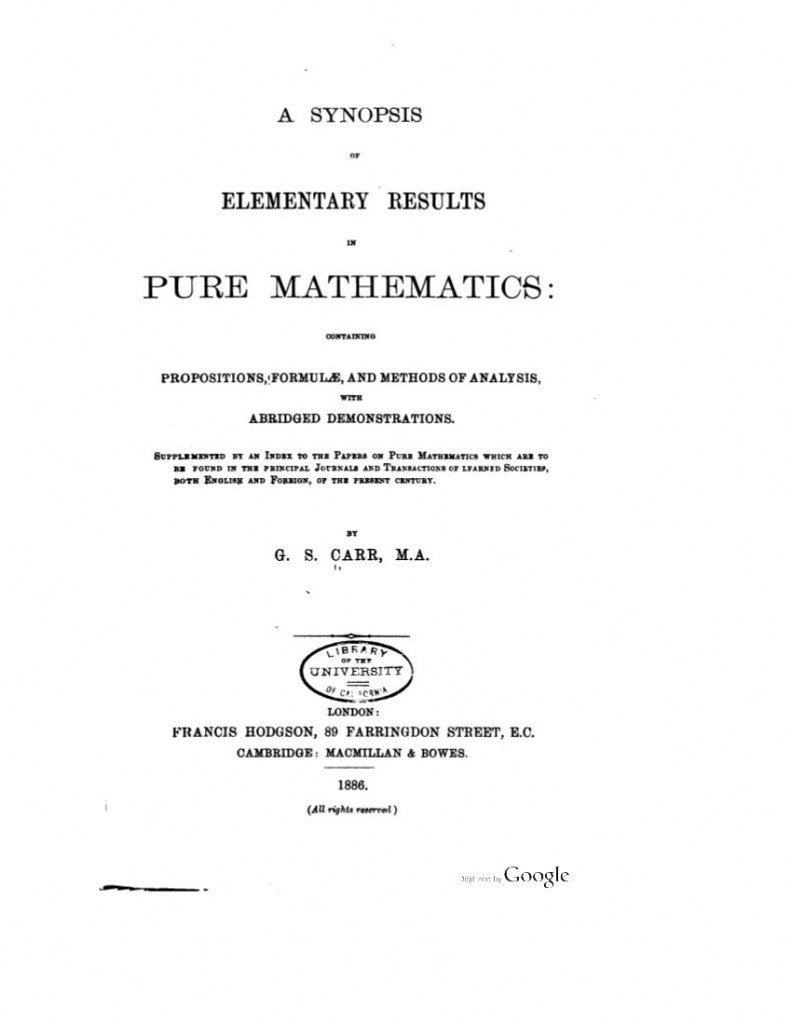
But the series are not really what has interested me for the last week–I want to discuss a book by George Shoobridge Carr, which Ramanujan studied as an adolescent.

Carr Title Page

Carr’s TItle Page

I first became aware of this book when reading The Man Who Knew Infinity, a few years ago.  This is a very good biography of Ramanujan written by science writer Robert Kanigel.  I feel compelled to quote the haunting first paragraph in Kanigel’s 2nd chapter:

It first came into his hands a few months before he left Town High School, sometime in 1903.  Probably, college students staying with Ramanujan’s family showed him the book.  In any case, its title bore no hint of the hold it would have on him:  A Synopsis of Elementary Results in Pure and Applied [sic] Mathematics.

George Carr’s book of 1886, which Ramanujan acquired at age 16, is a book of 5000 theorems, intended to be a study guide for the Tripos examination at Cambridge.  When I first read The Man Who Knew Infinity I found this transformational book very interesting. At that time I thought it unlikely that I would ever see a copy.  But last week I realized that the internet has provided one:  The entire book is freely downloadable from at least two different sources.

There is a copy available from the open library, and another (slightly more legible) version scanned by Google Books.

While Kenigel writes beautiful prose, he is not a mathematician.  In the ten or so pages he devotes to Carr’s book, he spends the majority of it proving Carr’s first formula, which happens to be for the difference of squares.  Nothing of the actual pleasure evoked by Carr’s book comes through.  But Carr’s book is wonderful, if only as a snapshot of mathematics education from a bygone age.

On pg 6 there are the square and cube roots of the numbers from 1 to 30, and a brief table of logs.  On the following page Burckhardt’s Factor Tables gives a factorization of all numbers from 1 to 990000.  Following this there is a table for the logarithm of the gamma function for  n= 1 to  n= 2 at small decimal increments.

What we call “radicals” are charmingly referred to as surds.  Rather than the modern “n!” for factorial, the symbol \lfloor n is used. This and other typography recur eerily in Ramanujan’s handwriting:

Ramanujan's Master Theorem

Ramanujan’s Master Theorem


By contrast, Hardy was using the modern factorial notation when he published A Course of Pure Mathematics in 1908.

With the verbosity, color pictures, and general feeling of grinning desperation that accompany modern textbooks, it is refreshing to read material in Carr’s spare and simple format.

Many topics he treats, even in the first volume, are no longer covered in a typical undergraduate mathematics education.

And then, there is the actual influence the book had on Ramanujan.

While my knowledge of number theory is modest (okay, slight), even I can see links between the material in Carr’s book and the later work of Ramanujan.  There is a surprisingly large amount of material concerning \Gamma(x) in Carr.  This function appears in a number of Ramanujan’s results, such as the Master Theorem, and the Interpolation Formula.  It also recurs many times in Ramanujan’s identities.
Carr includes a section on hypergeometric series, as well as a lengthy treatment of continued fractions, which were favorite topics of Ramanujan.  There is also a discussion of Bernoulli numbers, the subject of Ramanujan’s first published paper.


Posted in Uncategorized | 27 Comments

Some problems with Standardized Tests problems

The Standardized Test season is finally over for us, NYC public school students and parents. I don’t really want to discuss the pros and cons of the standardized tests here, but, rather, show the two math problems from my daughter’s test prep materials that stuck with me. I don’t remember the exact formulation, but they look something like this.

Problem 1 (3rd grade short-answer problem): Mary took the elevator from the 2nd floor 7 floors up and then 4 floors down. What floor is she at? Explain. You may want to draw a diagram to help you think.

The answers are judged on a scale from 1 to 4, 1 means below expectation, 2 – approaches expectation, 3 – meets expectation, and 4 – exceeds expectation. My daughter’s teacher showed me her guidelines – the examples of the students’ answers and the grades they are assigned. Unfortunately, I only remember two out of four, but here they are.

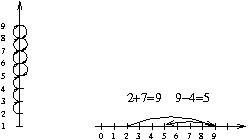
Answer 1 comes with the diagram on the left and says: “First Mary went up so I counted up by one seven times. Then Mary went down so I counted down by one four times. I arrived at 5. Mary is on the 5th floor.” Answer 2 comes with the diagram and “math sentences” on the right and says “Mary is on 5th floor”

One of the answers got the score of 2, and the other the score of 4. Can you guess which? How would you assign the grades? Both results are correct. Both have a diagram. In the first answer, a third grader still counts “by one”. The second does not offer much explanation, even though I would say that the diagram is explanatory enough. The first answer gets a score of 4, the second a score of 2. The high score for the first answer came as a surprise for me. I think that the third grader, who is supposed to know addition/subtraction “number facts”, like 2+7=9 and 9-4=5, should not be praised for counting by one. How does that “exceeds expectation” for a child who had been learning addition for at least three years by the end of the 3rd grade? But what I really think unfair is to assign “approaches expectation” to the second answer. The kid demonstrated mathematical maturity by writing “math sentences” rather than counting by one. The comments from the mathematics experts from the NYC Department of Education give the reason for low score. The student does not explain that addition is used because the elevator goes up, and subtraction because it goes down.

Apparently, this ’addition is used because… and subtraction because…’ key phrases is the main thing those who grade the tests are looking for. Kids are trained to write why they use addition (or subtraction, etc…), and it’s OK, it doesn’t hurt to be able to explain the reasoning. But don’t you think that it is the potential mathematician who is getting punished here, getting discouraged by the low grade? The kid demonstrated perfectly abstract mathematical thinking: so what if an elevator goes vertically, the horizontal number line does the job just as well, things does not have to be taken literally. The number line concept is introduced at the end of the first grade in the Everyday Mathematics series used by many schools, so it’s not that the kid invented it (or, worse, learned in Saturday “cram” school imposed on him or her by tiger parents). Even if he/she did, it is definitely not wrong. “Number facts” are there so that we don’t count by ones (what if there are too many ones to count?) By moving to the right on the number line, the student explained addition, and moving to the left, subtraction. How come it only “approaches expectation”, which means that it is still below expectation? Doesn’t it deserve a 3, at least?

Problem 2 (4th grade multiple choice): Estimate the product of 19 and 24. (a) 500 (b) 450 (c) 400 (d) 300.

My first thought is:19 is almost 20, 24 is almost 25, and it’s easy enough to multiply 20 and 25. So the answer must be 500. My second thought is: hmmm, isn’t the whole point of estimation that there is no single right answer? Different people find different ways to simplify their calculations and estimate things. What kind of tricky question is that? May be they want the number which is the closest to the true product? After all, the closer to the true result, the better estimation is. The product is 456, so the right answer is 450, then? No. The reasoning of the DOE math experts is that 19 rounds to 20, 24 also rounds to 20, so the answer is 400.
Now, may be, since I am not a native English speaker, I don’t really understand the meaning of the word “estimate”, but I am pretty sure it doesn’t mean “round to the nearest tens”. Nevertheless, that is what students are supposed to do. By the rules of rounding, 24 rounds to 20, not 25, all right, I know that. But doesn’t the whole point of estimation get lost here? The Webster’s dictionary says that to estimate is “to judge tentatively or approximately the value…”, to “determine roughly the size…”. In mathematics, to estimate means to find a lower or upper boundary of a quantity that cannot be calculated precisely. That’s not what the test question asks for. Are there other mathematical meanings of “estimate”? If the layperson’s meaning of the word “estimate” is assumed in the question, then what’s wrong with 500, or 450 for the answer?

Of course, children are trained to do what they are supposed to do, that’s what the test prep is for. They know that if they see the word “estimate”, they are supposed to round. But again, the ones who are better mathematicians, who can make more sophisticated calculations in their heads, get punished. And that’s a pity.

Posted in Uncategorized | 15 Comments